

A uniform allowance is the cleanest way to fund staff uniforms without policing every order. Here's what one is, how much employers typically give, the difference between an allowance, an allotment, and reimbursement, the tax and minimum-wage rules to know, and a policy template you can adapt.
Almost every uniform inquiry we get eventually lands on the same question: *how do we pay for this without somebody in the office approving every polo?* The answer most companies arrive at is a uniform allowance — a set budget per employee that funds the uniform and resets on a schedule. Simple in principle, and the details are where programs succeed or quietly fall apart.
Here's the practical version: what a uniform allowance actually is, how much employers typically give, the difference between an allowance, an allotment, and reimbursement (they are not the same thing), the wage and tax rules you need to know before you write the policy, and a template you can adapt. We build uniform programs for companies every week, so this is the version that survives contact with a real payroll department.

What is a uniform allowance?
A uniform allowance is a fixed amount of money or credit an employer gives each employee to cover required work apparel, usually per year, either as store credit against an approved catalog or as a stipend or reimbursement. It differs from a uniform allotment, where the employer issues specific garments directly, and from a rental program, where nobody owns anything.
The reason allowances are popular is that they cap the spend without anyone policing individual orders. You decide the number once, the employee decides which three polos, and the accounting is a single line per person per year. Past about twenty employees, this is the structure most companies end up with.
Allowance vs. allotment vs. reimbursement
These get used interchangeably and they shouldn't be, because they change who does the work and who carries the cost.
Allowance (store credit)
A dollar amount or point budget per employee, spent against an approved catalog — usually through an online company store. The company pays the store; the employee picks sizes and items within the budget. Nothing leaves the approved list, so brand control is built in. This is the version we set up most.
Allotment (issued garments)
The company decides the kit — *three polos and a jacket per technician* — and issues it. Zero choice, maximum consistency. Best for roles where the uniform is standardized down to the piece, like field techs or security posts. Many programs combine the two: an initial allotment for new hires, then an annual allowance for replacements.
Reimbursement
Employees buy approved items themselves and submit receipts, up to a cap. It pushes cash flow and errands onto staff, brand control depends on how tight your approved list is, and it creates paperwork. It's the most common structure at companies without a store — and the first thing most of them replace.
Stipend (cash)
Money added to pay with the expectation it's spent on uniforms. Simplest to administer and the weakest on brand control, and it has the biggest tax consequences, which we'll get to.
How much is a typical uniform allowance?
There's no industry-wide number, but there are useful anchors. The federal government's cap is $1,500 per employee per year for agencies that pay an allowance instead of furnishing uniforms, under 5 U.S.C. 5901 as updated in 2026 — that's the ceiling for roles with serious required gear, not a private-sector norm. Published corporate and public-sector policies we see cluster far lower, commonly a few hundred dollars a year or a fixed piece count like *five shirts per year*.
The better way to set the number is to price the kit you actually require and multiply by a realistic replacement rate. A client-facing office team needs two embroidered polos and a jacket, and they last a couple of years — that's a modest annual figure. A crew working outside in Arizona goes through four or five performance shirts a year and they're consumables, so the allowance has to reflect that or people quietly stop wearing the uniform. Our uniform program setup starts with exactly this math: what each role wears, what it costs, and how often it wears out.
The wage and tax rules to know first
Two sets of rules shape every uniform policy, and it's worth knowing them before you write a word. This isn't legal or tax advice — run the final policy past your accountant or employment counsel — but these are the things they'll ask about.
Minimum wage and required uniforms
Under the federal Fair Labor Standards Act, if a uniform is required by the employer, the cost of it can't be passed to the employee in a way that drops their pay below minimum wage or cuts into overtime — the Department of Labor's Fact Sheet #16 spells this out. Several states go further; California, for one, generally requires the employer to pay for required uniforms outright. Practically: if you require a logoed shirt, budget to provide it. Plain clothing that merely meets a dress code (black pants, white shirt) is usually treated differently.
Taxes: when an allowance is wages
Cash added to pay is generally taxable wages unless it's paid under an accountable plan — substantiated, for required clothing that isn't suitable for everyday wear — per the IRS rules on fringe benefits in Publication 15-B. Uniforms the company buys and issues, or store credit that can only be spent on logoed required apparel, are far easier to keep on the right side of that line than a stipend. This is one of the quieter reasons companies move from stipends to a store.
A uniform allowance policy template
A workable policy is short. Adapt this; the bracketed parts are yours to fill in.
Purpose. [Company] provides uniforms so employees present a consistent, professional appearance to customers. Required items. [Role]: [two logoed polos, one logoed jacket]; [Role]: [four logoed performance shirts, one hi-vis vest]. Items are ordered through the company uniform store at [link]; only listed items count as uniform. Initial allotment. New employees receive [kit] at no cost within their first [week]. Annual allowance. Each employee receives [$ amount or item count] on [date] each year for replacements, spent through the store. Unused allowance [does / does not] roll over. Replacement. Uniforms damaged in the course of work are replaced at company expense on request; lost items are replaced from the employee's allowance. Care and wear. Uniforms are to be worn [when]; employees are responsible for laundering. Separation. [Company-owned items are returned / uniforms are the employee's to keep] on separation. Questions go to [name].
Two things that make this policy hold up in practice: the approved catalog is the policy — if it isn't in the store, it isn't uniform — and the allowance resets on a date, not on request, so nobody has to ask and nobody has to approve. Both are things a store does automatically.
Running it without a spreadsheet
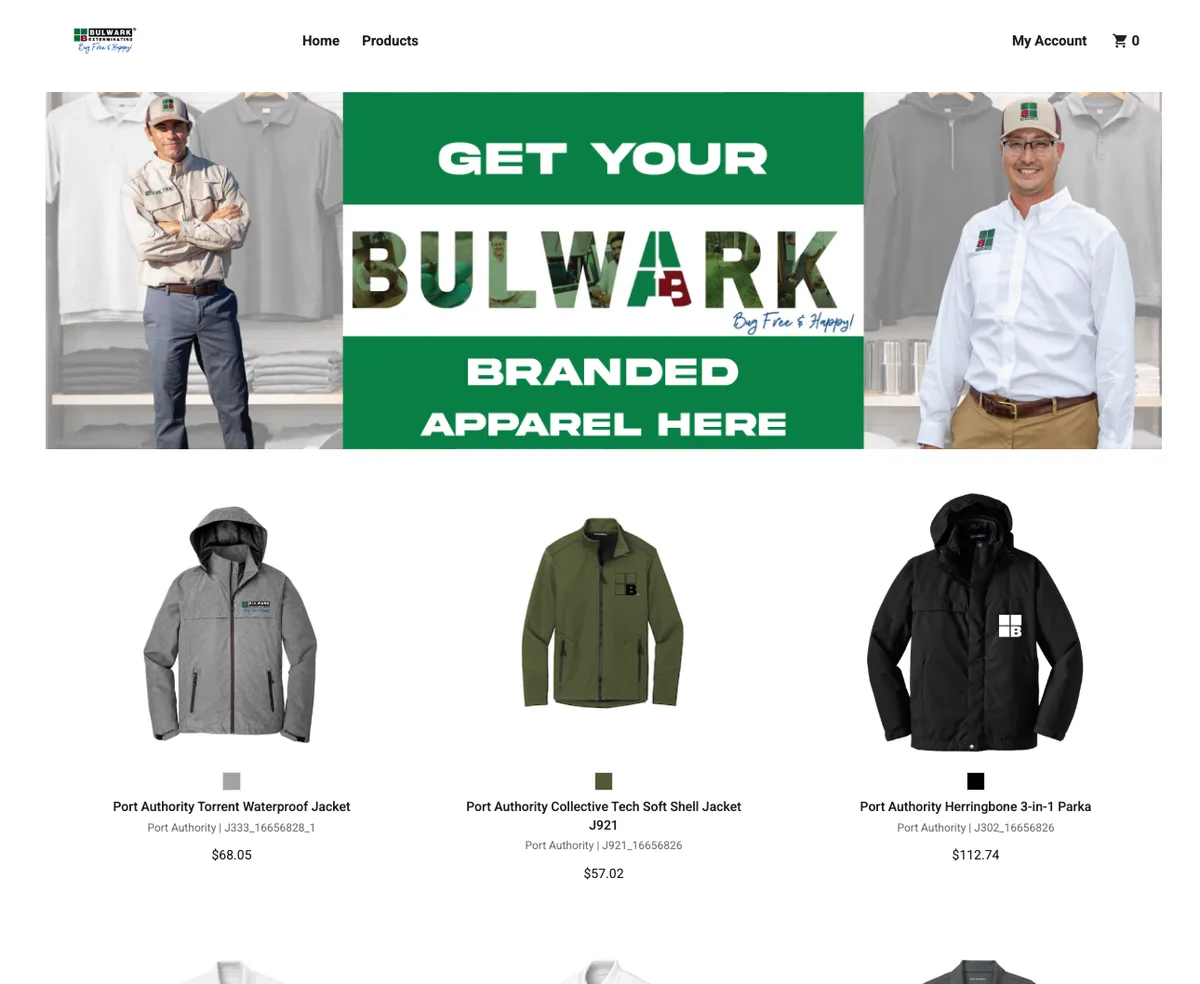
Every line of that template maps to a store feature. The approved catalog is the store's product list. The initial allotment is a kit a new hire orders on day one. The annual allowance is a credit that resets on your date. Size tracking is every order being tied to the person who placed it. Central billing is one invoice to the company, with employee-paid extras tracked underneath. That's the whole reason we build uniform programs on a store rather than a spreadsheet — the policy enforces itself.
If you're deciding between owning uniforms and renting them, the uniform rental guide covers that math honestly, and the employee uniform program guide walks through the setup step by step. There's no fee for the store or the program; you pay for the garments your team orders. For one-time runs, minimums are screen printing at 48 pieces, embroidery and DTF at 12 — and no minimum at all through the store.
Set up a uniform allowance with Heart & Hook
We build allowance-based uniform programs for businesses across Arizona and ship anywhere — embroidered polos, work shirts, jackets, and caps, all decorated in our own Mesa shop, with a private store that handles the allowance, the sizes, and the billing. Tell us your roles and headcount and we'll help you price the kit and set a number that actually works.
Send your logo and a rough breakdown of who wears what, and we'll come back with a free mockup, a clear quote, and a suggested allowance per role. Just let us know where you're starting from!
Frequently asked questions
- What is a uniform allowance?
- A fixed amount of money or credit an employer gives each employee to cover required work apparel, usually per year, either as store credit against an approved catalog or as a stipend or reimbursement. It differs from an allotment, where the employer issues specific garments directly.
- How much is a typical uniform allowance?
- There's no single norm. The federal cap for agencies that pay an allowance is $1,500 per employee per year, but private-sector policies commonly land at a few hundred dollars or a fixed piece count. Price the kit you require and multiply by how often it realistically wears out.
- What is the difference between a uniform allowance and a uniform allotment?
- An allowance is a budget the employee spends on approved items; an allotment is a specific set of garments the employer issues, like three polos and a jacket. Many programs combine them: an initial allotment for new hires and an annual allowance for replacements.
- Can an employer make employees pay for their own uniforms?
- Under federal law, the cost of a required uniform can't reduce an employee's pay below minimum wage or cut into overtime, and some states, including California, require the employer to pay for required uniforms outright. Plain clothing that merely meets a dress code is usually treated differently. Check your state's rules.
- Is a uniform allowance taxable?
- Cash added to pay generally is, unless it's paid under an accountable plan for required clothing not suitable for everyday wear. Uniforms the company issues, or store credit spendable only on logoed required apparel, are easier to keep non-taxable. Confirm the structure with your accountant.
- Does an unused uniform allowance roll over?
- That's a policy choice. Most companies let it expire on the reset date so the budget stays predictable, and handle genuine wear-and-tear replacements at company expense on request instead. Either way, write it into the policy so nobody has to ask.
- What should an employee uniform policy include?
- Purpose, the required items by role, where they're ordered, the initial allotment for new hires, the annual allowance and its reset date, replacement rules for damaged and lost items, care and wear expectations, what happens on separation, and who to ask. Keep it short and make the approved catalog the policy.
- How do you administer a uniform allowance without a spreadsheet?
- Through an online company store: the approved catalog is the product list, the allowance is a credit that resets on your date, every order is tied to the employee for size tracking, and billing runs centrally. The policy enforces itself.
Need uniforms for your crew?
Tell us how many people need gear and what they wear on the job. We'll send a free logo mockup and a quote, and keep your logo on file so every reorder matches.
Get a free uniform quote